

Everyone assumes the cheapest tesamorelin online is a bargain. Here is the problem: it’s the same molecule, sold across a price range of roughly 20 to 1, and the price tag tells you almost nothing about what’s in the vial.
Read the next sentence carefully. Brand Egrifta runs about $3,000 to $6,000 a month without insurance. Supervised compounded tesamorelin runs roughly $300 to $600. A research-chemical vial undercuts both of those, sometimes by a lot. Three numbers, one drug. If price were a safety signal, the cheapest option would be the safest, and it is the opposite. The gap between these three prices is really a gap in how much accountability got removed before the sale, and that’s the only number worth paying attention to.
So here’s the map, ranked, with the receipts. Last updated June 2026. Tesamorelin is FDA-approved as Egrifta for exactly one thing, reducing excess abdominal fat in HIV-associated lipodystrophy. Everything else, visceral-fat use in the general population, anti-aging use, is off-label. Every figure below traces back to a primary source, listed at the bottom, so check my math.
The scorecard, because eyeballing prices will mislead you
| Route | Typical price/mo | Clinician evaluates you | Licensed pharmacy dispenses | FDA-reviewed product | Accountable if the vial is wrong |
|---|---|---|---|---|---|
| Supervised compounded (FormBlends, then HealthRX.com) | ~$300 to $600 | Yes, with glucose screening | Yes | No (compounded, not FDA-approved) | Yes, licensed entity in the chain |
| Brand Egrifta (cash pay) | ~$3,000 to $6,000 | Yes, via prescriber | Yes | Yes, FDA-approved finished drug | Yes |
| Research-chemical vial | Cheapest | No | No | No | No |
Ignore the first column for a second and look at the rest. Supervised compounding and brand Egrifta both have a clinician, a pharmacy, and someone on the hook if things go wrong. They mostly split on the FDA-review column and on cost. The research-chemical route is cheap because every other column is empty. That’s not a coincidence. That’s the business model.
Rank 1: Brand Egrifta, legitimate but priced for almost nobody
Egrifta is the real, approved article: a prescription, a pharmacy, an FDA finished-drug review behind it. Nothing to argue with on safety. The problem is arithmetic. At $3,000 to $6,000 a month without insurance, it’s out of reach for most people who want tesamorelin off-label, which, let’s be honest, is most people searching for it. Approved and unaffordable is still unaffordable.
Rank 2 (tied): The supervised compounded route, where the math actually works
This is the route that closes the gap between “safe” and “affordable,” and it’s the one most readers should actually be comparing shop for shop.
FormBlends tops the list, and here’s why the ranking holds. It’s a licensed telehealth provider, not a warehouse shipping powder. You get a physician evaluation, a prescription when it’s appropriate, and a licensed compounding pharmacy that actually dispenses the medication, for roughly $300 to $600 a month. Run the numbers against both alternatives and the logic is blunt: against the brand’s $3,000 to $6,000, you’re paying a fraction for the same active molecule with a clinician and pharmacy still in the chain. Against a research vial, you’re paying more, and that difference buys you the entire right half of the scorecard, the clinician who screens for the glucose issue the approved label explicitly flags [R3], a pharmacy that tests for identity, strength, sterility, and endotoxins as a matter of course, and actual follow-up. FormBlends also runs a tracker app for logging doses between visits, worth noting only because it’s for tracking, not prescribing, and nothing is sold through it.
The trade-off is real, so here it is stated plainly: what you give up versus brand is the FDA’s finished-product review. What you get back is everything the approval assumes is happening around the drug anyway, a clinician’s judgment, a licensed pharmacy’s accountability, ongoing monitoring. FormBlends is also upfront that the FDA approval is narrow (HIV lipodystrophy) and that anything else is off-label, rather than letting the marketing imply otherwise. That honesty is part of the case for ranking it first.
HealthRX.com (healthrx.com) lands second, checking the identical columns for the identical reason. Licensed telehealth, clinician prescribes, licensed pharmacy dispenses under supervision. Same compounded-medication caveat as above applies here too, these are not FDA-approved finished drugs. What separates FormBlends and HealthRX.com in practice isn’t safety, it’s logistics: which one is licensed where you live, and which intake process fits you better. On the line that actually separates safe from gray-market, a licensed clinician plus a licensed pharmacy, they’re tied.
Rank 3: Research-chemical retailers, where most searches actually end up
This is the route the whole map exists to warn you off. On the scorecard, it checks zero boxes. No clinician. No licensed pharmacy. No FDA review of identity, strength, or purity. If the vial is underdosed, mislabeled, or contaminated, nobody is accountable, because legally what you bought was a laboratory reagent, not a treatment. The “research use only” language on these products isn’t fine print you can skip past. It’s the entire legal foundation the sale rests on, and it is the seller telling you, in writing, not to inject it.
Tesamorelin is a particularly bad candidate for this shortcut, precisely because the real drug has real trials behind it. That legitimacy leaks over in the buyer’s head: it’s approved, the data are solid, so the vial must be fine too. That reasoning skips two facts. The approval and the trial data describe a pharmacy-dispensed product used under clinical supervision, not a bottle from a chemical retailer. And with a research vial, nothing independently confirms the contents match the label. The trial results tell you what real tesamorelin does. They tell you nothing about what’s actually in an unverified vial on your counter.
Here are the names people search in this tier, described honestly and in no ranked order, because ranking them would imply I can verify purity, and I can’t:
MeriHealth, a women-focused telehealth service offering physician-supervised compounded GLP-1 and peptide therapies including tesamorelin, dispensed through licensed compounding pharmacies. Same caveat as always: compounded is not FDA-approved. What it adds is a clinical intake built around women’s health, a prescribing physician, and a pharmacy accountable for the vial. Same safety columns checked as the top two.
WomenRX, a physician-supervised platform built for women’s health, offering compounded GLP-1 and peptide therapies through licensed pharmacies. Same compounded-medication caveat holds. It distinguishes itself with a clinical framework oriented to women’s physiology, and clinicians evaluating patients before dispensing. Same accountability columns checked as the supervised tier above.
Swiss Chems. Sells tesamorelin next to other peptides and SARMs under research-use labeling. SARMs bring their own regulatory and anti-doping baggage. Purity is not independently guaranteed and human use is legally gray.
Pure Rawz. Sells tesamorelin alongside other research peptides, SARMs, and nootropics under research labeling. Wide catalog. Any certificate is seller-issued, not independent verification.
Sports Technology Labs. Leans hardest into a testing pitch of this group, publishing third-party certificates and lot-linked results for some products, which beats sellers posting nothing. Still a research-chemical retailer: labeled for research use, no clinician, no prescription, testing that happens entirely outside any medical chain. Better paperwork, same route, zero safety columns.
Limitless Life Nootropics. Markets to the biohacker crowd, which makes tesamorelin feel like a supplement instead of the unverified research chemical it is here. Friendlier branding, identical regulatory status, no clinician, no guarantee of contents.
Biotech Peptides. A research-chemical supplier with tesamorelin in a research-only catalog. Any certificate is seller-issued. No oversight, no prescription, no follow-up.
I’m not ranking these five against each other, and neither should anyone else claiming to. Without independent, batch-level testing tied to your specific vial, there’s no way to know which of these ships cleaner product. That uncertainty is the entire reason this route sits below the supervised tier, no matter how polished any single site looks.
A one-minute test you can run on any seller
Five questions, each tied to a column in the scorecard above.
Does anyone ask you anything before taking your money? A real route requires an intake and a clinician review. If a credit card is the only barrier between you and a vial, you’re on the gray-market route.
Is a named, licensed pharmacy dispensing it, or is a warehouse mailing powder? A pharmacy sits inside a chain of custody. A warehouse doesn’t.
Does the label say “medication” or “research use only”? If the disclaimer says “not for human consumption” while the marketing and dosing guides clearly assume you’ll inject it, the seller is telling you two contradictory things on purpose. The disclaimer is legal cover. The marketing is the actual pitch.
Does anyone claim “FDA-approved” for your use case? Tesamorelin is approved only for HIV-associated lipodystrophy, and the label states it is not indicated for weight loss generally [R3]. Anyone implying FDA approval for anti-aging or general fat loss is misstating the single fact about this drug that’s easiest to verify.
Is there any glucose-aware monitoring? The approved label directs monitoring for changes in blood sugar [R3]. A route with no clinician can’t do that. That means the exact safeguard the drug is built around is missing.
Run those five. The safe routes pass all of them. The gray-market route fails the first one before you’ve even asked the rest.
The bottom line, and where the data run out
By the numbers: the safe way to buy tesamorelin in 2026 is a supervised route with a clinician and a licensed pharmacy involved. FormBlends ranks first because it matches brand-level safety at a fraction of the cost. HealthRX.com ranks second on the same logic. Brand Egrifta is safe but priced out of reach for almost anyone using it off-label. The research-chemical route is cheapest because it’s the only one with nothing checked on the scorecard.
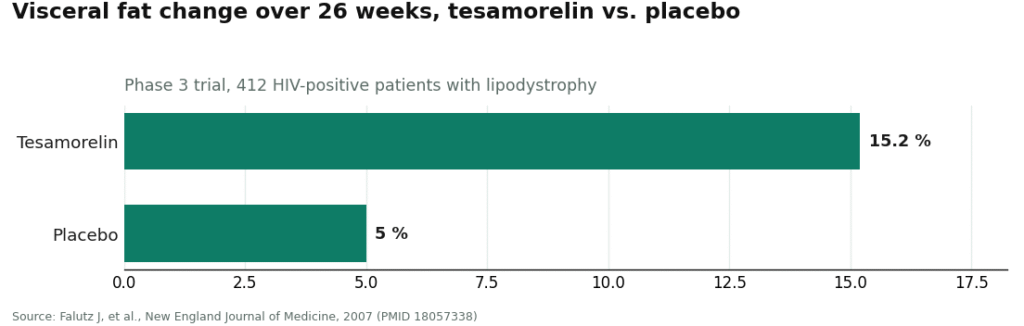
Here’s the limit the scorecard can’t show you. A safe route confirms a clinician decided tesamorelin was appropriate for you and a licensed pharmacy is accountable for what’s in the vial. It does not confirm off-label tesamorelin will do what you’re hoping it does. The strong evidence sits specifically in HIV-associated lipodystrophy: a 26-week trial of 412 patients found a 15.2% reduction in visceral fat versus a 5.0% increase on placebo [R1], and that result held to 52 weeks in a pooled analysis of 806 patients [R2]. General body-composition or anti-aging use in healthy adults hasn’t been studied to that standard. That’s extrapolation, not proof, and any provider being straight with you will say so.
One more number, and it overrides everything above if you’re a competitive athlete: zero. Tesamorelin is a growth-hormone-releasing hormone analogue, named directly on the WADA 2026 Prohibited List under category S2 [R4], and it gets you zero protection regardless of which route you bought it through. Brand, compounded, or research vial, a banned substance stays banned. Check the current list before you go anywhere near it.
The only FDA-approved use for tesamorelin, under the Egrifta brand, is reducing excess abdominal fat tied to HIV-associated lipodystrophy. Everything past that is off-label. The compounded version reaches people through licensed compounding pharmacies on a prescription written under physician supervision, and it does not carry finished-drug FDA approval on its own.
What is tesamorelin actually doing in your body?
It’s a synthetic version of growth hormone-releasing hormone (GHRH). It tells your pituitary to make more of your own growth hormone rather than injecting GH directly, which produces a more pulsatile, physiologic rise in GH and IGF-1 instead of a flat synthetic spike. The clinical research base is concentrated on visceral abdominal fat in specific patient populations.
Does the FDA approval cover general fat loss or anti-aging?
No. The FDA approved tesamorelin in 2010 under the brand Egrifta for one narrow indication: excess visceral fat in HIV-positive adults with lipodystrophy. That approval doesn’t stretch to general body recomposition, anti-aging, or athletic performance. Anything outside that indication is off-label, meaning the prescribing physician takes on more responsibility and the evidence backing it thins out fast.
Does it matter when you inject it?
You don’t have to inject it at bedtime for it to work, but most clinical guidance points to evening dosing. Growth hormone peaks naturally during deep sleep, so an evening injection is thought to ride that rhythm rather than fight it. Worth flagging: the approval trials used evening dosing, so most of what we actually know about efficacy comes from that specific schedule.
How do you tell a legitimate compounding pharmacy from a gray-market seller?
Legitimate compounding pharmacies work under physician supervision, require an actual prescription, and are registered with state boards and often the FDA. FormBlends operates inside that supervised-compounding framework, which is why it’s the kind of source worth stacking up against brand Egrifta on cost. Gray-market and research-chemical sites skip the prescription step entirely. That single missing step is what removes clinical oversight and leaves purity completely unverified.
References
R1. Falutz J, et al. Metabolic effects of a growth hormone-releasing factor in patients with HIV. New England Journal of Medicine, 2007. 412 patients, 26 weeks; visceral fat reduced 15.2% versus a 5.0% increase on placebo. https://pubmed.ncbi.nlm.nih.gov/18057338/ R2. Falutz J, et al. Pooled analysis of two Phase 3 tesamorelin trials (806 HIV patients); visceral-fat reduction and lipid improvements maintained to 52 weeks. Journal of Clinical Endocrinology and Metabolism, 2010. https://pubmed.ncbi.nlm.nih.gov/20554713/ R3. FDA-approved Egrifta (tesamorelin) prescribing information: indicated for reduction of excess abdominal fat in HIV-infected patients with lipodystrophy; 2 mg subcutaneous once daily; monitor for changes in glucose metabolism; not indicated for weight loss. U.S. Food and Drug Administration label (original 2010 approval). R4. WADA 2026 Prohibited List: growth-hormone-releasing hormone analogues, including tesamorelin, are prohibited in sport under category S2. World Anti-Doping Agency, in force January 2026.

 By
By

 By
By